What research in China and Malaysia contributes to UK economic preparedness—and where evidence does not transfer.
The following assessment uses the supplied supervisor synthesis by Vosough Ahmadi (2026), not independently re-analysed dissertation datasets. The original dissertations are unpublished University of Edinburgh MSc work. Their contribution is to decision framing, mechanisms and research priorities. The programme, author and title are given in the references. Findings are not treated as peer-reviewed UK coefficients or as evidence that the present model has been validated.
5.1 Zang: the investment boundary changes the answer
Yifei Zang’s Ecological Economics dissertation assesses alternative ASF control strategies in China over 2018–2023. As summarised, a compartment scenario with 30% national slaughter coverage reports a BCR of 4.68 and effectiveness thresholds of 13.4% with consumer benefits and 20.4% without them. These are outputs of that dissertation’s model and its chosen benefit boundary, not observed programme returns. Parameter refinement is an explicit qualification in the synthesis.
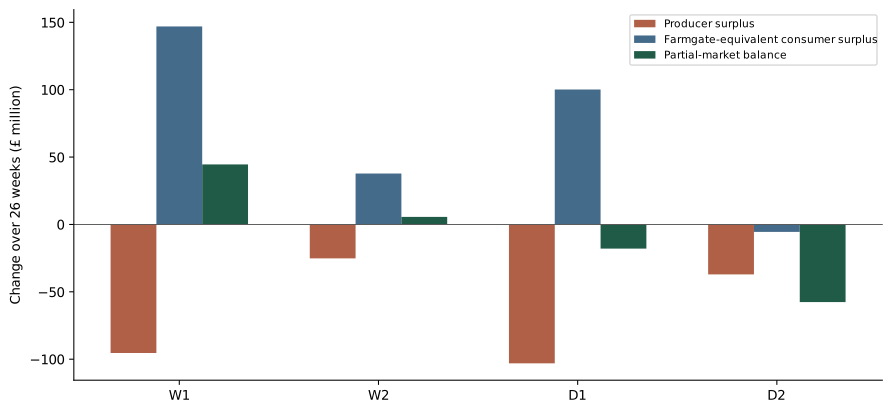
The transferable lesson is to state whose benefits enter the numerator, what coverage means and which costs are required across the chain. The present UK illustration therefore distinguishes private loss avoidance from consumer surplus, separates participation, recognition and continuity, and shows an infeasible recognition threshold when costs exceed attainable benefits. The numerical resemblance of a 30% coverage example does not establish UK calibration; none of Zang’s reported BCR or effectiveness thresholds is used as a UK result.
5.2 Yang: output recovery and productive capacity are different
Shirong Yang’s Environmental Protection and Management dissertation examines Sichuan–Chengdu production, price patterns and organisational adaptation. The supervisor synthesis describes recovery in output or offtake alongside lower pig and sow inventories. This supports using several recovery indicators rather than reading slaughter recovery as complete restoration of the production system. Descriptive co-movement does not by itself identify the causal effect of consolidation, technology or any individual policy.
The corresponding UK design implication is practical: report breeding stock, marketed output, capacity use and business cash separately. A processing backlog programme should not be presented as a model of breeding-herd recovery. An integrated enterprise may restore sales by changing throughput or sourcing while still carrying replacement costs and financial stress. The current separate breeder and liquidity accounts make that distinction visible, but they do not estimate the organisational changes documented in Sichuan.
5.3 Zaidun: compensation and import dependence alter incidence
Dayang Ku Farah Ana Binti Zaidun’s Food Security dissertation combines Malaysian production and trade evidence with interviews, drawing on Asian experience during 2018–2024. The synthesis describes reduced domestic self-sufficiency, greater imports and concerns that compensation for official culling can leave earlier animal deaths outside payment. The interview base supplies context and hypotheses; it cannot establish population-wide effects or a causal relationship between a compensation rule and reporting behaviour.
The transferable questions concern eligibility, who lacks liquidity before payment, and whether recovered consumption is supplied domestically or through imports. The UK application consequently shows compensation as an explicit transfer, defaults it to zero, and tests payment delays separately from the rate. The market model allows imports to respond to price but does not estimate a long-run restructuring of domestic capacity. Those are distinct dimensions of resilience.
Table 15. From dissertation lesson to an auditable UK research question
Indirect effects, shared services and recent research
Savioli et al. (2022) supplies the principal stakeholder-to-impact organising approach in Table 8. The priority mechanisms include transport logistics, demand response, preventing contact between wild boar and domestic pigs, and slaughter logistics. The current application quantifies selected economic pathways; it does not claim to have priced every identified measure. The transport and control allowances remain placeholders until a bottom-up UK inventory is costed.
Gren et al. (2024) reports approximately €28m in response costs for Sweden, with around 40% classified as indirect. That case demonstrates that local restrictions can affect activities outside livestock production. Its geographic setting, affected activities and accounting definitions differ from this UK scenario exercise. Neither the euro total nor the indirect-cost proportion is applied as a UK multiplier.
Helgesen and Barratt’s EPIC brief defines its indirect-cost window after disease freedom and models linked commodity price and revenue effects. In its medium scenario, a 20% national herd cull is associated with a British pork-producer revenue loss of £53.50m. Revenue is not surplus, and post-freedom persistence is not the same period as the constant disruption used here. The comparison identifies an omitted recovery channel; it does not provide a second number to add to Table 9.
Shakil et al. (2025) illustrates why a vertically connected livestock model can represent incidence beyond the farm gate. A UK extension would need stage-specific prices and processing costs, product conversion, substitution and trade destinations. The present single-market approximation does not implement that published vertical model. Making the distinction explicit prevents the literature review from suggesting analytical capabilities absent from the code.
6.3 Epidemiological evidence and economic uncertainty
Shaw, McLure and Glass (2024) examines how ASF model assumptions and structure affect conclusions. Fay et al. (2025) examines the importance of seasonal timing in host–pathogen dynamics. These open research contributions support treating duration and production effects as uncertain and potentially dependent. They do not justify selecting one UK loss percentage, nor does citation supply current UK validation. This paper models economic consequences conditional on specified disruptions and contains no simulation of infection or transmission.
The implication for future economic work is to preserve provenance at any model interface: record the scenario definition, geographic coverage, time resolution and uncertainty of externally supplied consequences before translating them into economic inputs. Current authorised data, independent validation and jurisdiction-specific policy interpretation would be required for an operational forecast. Historical haulage evidence in Porphyre et al. (2020) remains a reason to examine shared-service disruption, rather than a current map of vulnerable routes.
Full references and source links